Boyd: The Fighter Pilot Who Changed the Art of War by Robert Coram
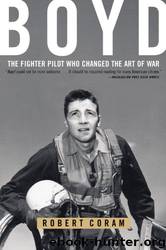
Author:Robert Coram [Coram, Robert]
Language: eng
Format: epub
Tags: Autobiography, MAAC
ISBN: 9780316881463
Google: wWHIpt3EowQC
Amazon: 0316796883
Barnesnoble: 0316796883
Goodreads: 8854089
Publisher: Little, Brown
Published: 2002-11-01T00:00:00+00:00
It was in 1969 that Boyd laid the cornerstone for one of his greatest bureaucratic victories.
Two players crucial to the victory, Defense Secretary Melvin Laird and Deputy Defense Secretary David Packard, moved onstage early in the year. But the drama was not yet ready to be played out. One character was missing.
He was a full colonel, a volatile, hand-waving test pilot and fighter pilot named Everest Riccioni. Riccioni took over the Development Planning Office, part of the department where Boyd worked in early 1969. Boyd and Sprey briefed Riccioni on their early work with the F-X and found a receptive audience. Riccioni had long favored the idea of a lightweight, high thrust-to-weight fighter similar in some respects to what Boyd and Sprey wanted.
Riccioni is a curious fellow. He is a professional Italian in whom both tears and laughter are always near the surface. He is so sensitive N that his feelings can be hurt with a harsh look, and he has an unending need for recognition. Riccioni flew P-38s and P-51s in World War II and then got an undergraduate degree in aeronautical engineering and a masters degree in applied mathematics before going to MIT to work on a doctorate in astronautical engineering (he did the course work but dropped out without writing a thesis). He was an instructor at the Air Force Academy, where he taught Astronautics 551—a course dealing with the mathematical physics of space motion, perhaps the most advanced course at the Academy. Both Riccioni’s brilliance and naïveté were manifested at the Academy when he wrote a book called Tigers Airborne, a book on aerial tactics. In the book Riccioni said Air Force tactics not only were stupid, but could get pilots killed in combat. He said it in such a harsh and unequivocal fashion that the Air Force had to respond: he was not allowed to publish the manuscript, and, unbeknownst to him, his superiors sent the manuscript to Boyd for comments. Boyd then was stationed at Eglin and did not know Riccioni, but he sensed that the Air Force was looking for a reason to end the man’s career. And he knew that if he—as author of the “Aerial Attack Study” and the man whom the Air Force acknowledged as its supreme aerial tactician—criticized the manuscript, Riccioni’s career would be over. He read the manuscript and said he disagreed with Riccioni’s conclusions but that only by being exposed to a wide variety of thought on aerial tactics could American fighter pilots remain the best-trained pilots in the world. His refusal to pan the manuscript and his strong recommendation not to fire the author saved Riccioni’s career.
It was one of those curious twists of fate that Riccioni now became the spark plug that helped Boyd resurrect the glory that could have been the F-15. Riccioni was in a Pentagon R&D job where he could contract for research studies. Boyd and Sprey told Riccioni how their idealized lightweight fighter had been gold-plated and was becoming heavier by the day.
Download
This site does not store any files on its server. We only index and link to content provided by other sites. Please contact the content providers to delete copyright contents if any and email us, we'll remove relevant links or contents immediately.
| Africa | Americas |
| Arctic & Antarctica | Asia |
| Australia & Oceania | Europe |
| Middle East | Russia |
| United States | World |
| Ancient Civilizations | Military |
| Historical Study & Educational Resources |
The Radium Girls by Kate Moore(12036)
100 Deadly Skills by Clint Emerson(4932)
Rise and Kill First by Ronen Bergman(4797)
The Templars by Dan Jones(4695)
The Doomsday Machine by Daniel Ellsberg(4493)
The Rape of Nanking by Iris Chang(4224)
Killing England by Bill O'Reilly(4008)
Stalin by Stephen Kotkin(3973)
Hitler in Los Angeles by Steven J. Ross(3949)
12 Strong by Doug Stanton(3555)
Hitler's Monsters by Eric Kurlander(3352)
Blood and Sand by Alex Von Tunzelmann(3207)
The Code Book by Simon Singh(3197)
Darkest Hour by Anthony McCarten(3137)
The Art of War Visualized by Jessica Hagy(3014)
Hitler's Flying Saucers: A Guide to German Flying Discs of the Second World War by Stevens Henry(2759)
Babylon's Ark by Lawrence Anthony(2686)
The Second World Wars by Victor Davis Hanson(2529)
Tobruk by Peter Fitzsimons(2521)
